Review – We Are All Completely Beside Ourselves by Karen Joy Fowler

Hi,

I’m still suffering a massive book hangover after reading Karen Joy Fowler‘s We Are All Completely Beside Ourselves which was shortlisted for the 2014 Man Booker Prize and has won the Pen Faulkner Award and the California Book Award.
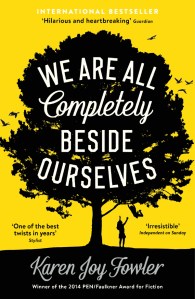
We Are All Completely Beside Ourselves
Image provided by Serpent’s Tail¹
Synopsis quoted from Serpent’s Tail¹:

Rosemary’s young, just at college, and she’s decided not to tell anyone a thing about her family. So we’re not going to tell you too much either: you’ll have to find out for yourselves, round about page 77, what it is that makes her unhappy family unlike any other. Rosemary is now an only child, but she used to have a sister the same age as her, and an older brother. Both are now gone – vanished from her life. There’s something unique about Rosemary’s sister, Fern. And it was this decision, made by her parents, to give Rosemary a sister like no other, that began all of Rosemary’s trouble.

My Thoughts:

Karen Joy Fowler’s novel We Are All Completely Beside Ourselves is set in the contemporary United States, but the book’s focus isn’t on the setting.

Rosie, our main character, is a young woman telling the story of her sister’s disappearance. When Fern vanished, both Rosie and Fern were still small children. Since then, Rosie feels as if half of herself is missing. She is insecure and has a hard time making friends. At college, Rosie meets Harlow, a girl very different from herself. Harlow is outgoing, takes risks, doesn’t think about her actions. Rosie feels drawn to Harlow even though the latter, in my eyes, isn’t a very likeable character. We Are All Completely Beside Ourselves lives from characterization and the relationships between characters. Most of the time this works out brilliantly, but Rosie’s & Harlow’s “friendship” just doesn’t work that well for me. I can’t understand why anyone wants to be friends with someone like Harlow.

We Are All Completely Beside Ourselves was quite the surprise. I had no idea what it really was about. So if you don’t know either, you are in for a treat. While the story is very unusual, Ms Fowler still manages to embed it into a perfectly normal environment. I am glad that the novel doesn’t get kitschy at any point because I sometimes feared it would. If you’d like to pick up a gripping novel that stays with you for a long time after reading, I’d recommend We Are All Completely Beside Ourselves.

4beans

¹ http://www.serpentstail.com/book-detail/9781846689666

Review – The Last Runaway by Tracy Chevalier

Hi,

Today, I’d like to introduce you to Tracy Chevalier‘s novel The Last Runaway. It took me quite some time to pick it up and finally read it, but when I did, I was thoroughly entertained.

The Last Runaway
Image provided by HarperFiction¹
Synopsis quoted from HarperFiction¹:

When modest Quaker Honor Bright sails from Bristol with her sister, she is fleeing heartache for a new life in America, far from home. But tragedy leaves her alone and vulnerable, torn between two worlds and dependent on the kindness of strangers.

Life in 1850s Ohio is precarious and unsentimental. The sun is too hot, the thunderstorms too violent, the snow too deep. The roads are spattered with mud and spit. The woods are home to skunks and porcupines and raccoons. They also shelter slaves escaping north to freedom.

Should Honor hide runaways from the ruthless men who hunt them down? The Quaker community she has joined may oppose slavery in principle, but does it have the courage to help her defy the law? As she struggles to find her place and her voice, Honor must decide what she is willing to risk for her beliefs.

My Thoughts:

Tracy Chevalier’s historical novel The Last Runaway is mainly set in 19th century Ohio. The author paints very vivid pictures of North America’s rural landscape. We ride carriages through high corn fields and feel the summer heat before the storm. I particularly enjoyed the impressive descriptions of the sky prior to thunderstorms.

Honor Bright, the main character, is a shy and quiet young Quaker woman with a mind of her own. She develops into an unconventional Quaker and manages to surprise us. Other great characters are Belle and Donovan. Belle is a safe haven for Honor, a home away from home and in her own way a very charming character. Donovan, on the other side, is mysterious and scary but he does provide some attraction and without him the book would be a bore. The remaining characters, however, are a bit flat.

The Last Runaway is told in third person narration interspersed by various letters. This set-up makes the novel lively, even though it is a quick read anyways. The Last Runaway is gripping until the very end. You really want to know how Honor will find a way to be happy. The ending however feels a little forced. The Last Runaway is a novel for those who are passionate about the American Frontier, stories on the Underground Railroad, or just good, old historical fiction.

3beans(actually, 3.5 magic beans)

¹ http://www.harpercollins.co.uk/titles/9780007350346/the-last-runaway

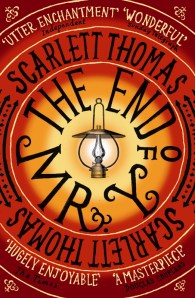
Review – The End of Mr Y by Scarlett Thomas

Hi,

Today’s review was pretty hard to write. It’s about Scarlett Thomas’ novel The End of Mr Y. I still don’t really know what to make of it. But see for yourself 🙂

The End of Mr Y
Image provided by Canongate¹
Synopsis quoted from Canongate¹:

When Ariel Manto uncovers a copy of The End of Mr. Y in a second-hand bookshop, she can’t believe her eyes. She knows enough about its author, the outlandish Victorian scientist Thomas Lumas, to know that copies are exceedingly rare. And, some say, cursed.
With Mr. Y under her arm, Ariel finds herself thrust into a thrilling adventure of love, sex, death and time-travel.

My Thoughts:

The End of Mr Y starts out in present-day England and slowly leads you into a parallel world, called the Troposphere, which frequently changes its appearance. Traveling through this strange world, you can feel these changes just like the protagonist Ariel Manto does, so don’t worry if at some point you can’t see clearly and the world around you starts to blur.

Ariel Manto is a young scientist who is curious and very isolated. Her life is dull and in her self-destructive ways she doesn’t seem to want to change that. I wasn’t really able to connect with Ariel, but there is a character in this book who I like. He is a very powerful one who makes an appearance when he’s needed most. In a way he reminds me of a wise and loving grandfather. (I’m not talking about Professor Burlem here.)

The End of Mr Y is a very creative book with an exciting plot. Nevertheless, it has too much non-fiction content for my taste. I’m reading fiction to relax and I don’t want to be deluged with philosophical questions. At some point I just started to skip these passages. Fortunately, they aren’t really necessary to follow the story. Another letdown is the ending which just doesn’t fit the complexity of the book. So as you can see, The End of Mr Y is a book that philosophers will love and that you should read if you’d like to enter a very odd parallel world.

3beans

¹ http://www.canongate.tv/the-end-of-mr-y-paperback.html

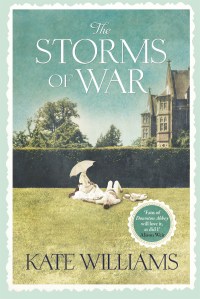
Review – The Storms of War by Kate Williams

Hi,

Don’t judge a book by its cover! This sentence holds especially true for Kate WilliamsThe Storms of War. Don’t expect your usual light historical/romantic fiction fare. Why? Just read my review.

Thank you Orion Books for a copy of the book in exchange for an honest review.

The Storms of War
Image provided by Orion Books¹
Synopsis quoted from Orion Books¹:

In the idyllic early summer of 1914, life is good for the de Witt family. Rudolf and Verena are planning the wedding of their daughter Emmeline, while their eldest son, Arthur, is studying in Paris and Michael is just back from his first term at Cambridge. Celia, the youngest of the de Witt children, is on the brink of adulthood, and secretly dreams of escaping her carefully mapped-out future and exploring the world.

But the onslaught of war changes everything and soon the de Witts find themselves sidelined and in danger of losing everything they hold dear. As Celia struggles to make sense of the changing world around her, she lies about her age to join the war effort and finds herself embroiled in a complex plot that puts not only herself but those she loves in danger.

My Thoughts:

Kate Williams’ The Storms of War is set during the Great War in England and France and the detailed descriptions of the various settings help you to envision what the war must have been like. While Williams paints a clear picture of the gruesome wartime at the Western Front in France, she doesn’t forget to also write about the state of her settings before and after the war. One of these places is Stoneythorpe Hall, the home of the de Witt family, and I really enjoyed reading about how it changed during the war.

In my opinion, this novel is the coming-of-age story of Celia de Witt, our main character. She is the youngest of the de Witt children and after the war breaks out she has to grow up very fast. Child-like, dreamy and naive Celia soon adapts to the harsh reality of the wartime and turns into a practical young woman. Only later in the book, she somehow seems to be out of character for a short while. I could write a lot about the other characters. They all seem to have their own story to tell which isn’t surprising, as this is the first book in a trilogy.

As I said before, when I saw the cover of The Storms of War, I expected light historical/romantic fiction. What I didn’t expect is a novel that is filled with blood and causes so much pain. I was glad it turned out that way. The Storms of War is a well-researched book that I’d recommend to everyone who can stomach a hefty dose of war and its consequences on people’s lives.

4beans

¹ https://www.orionbooks.co.uk/books/detail.page?isbn=9781409139881

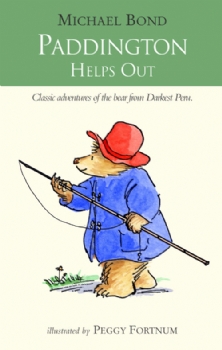
Review – Paddington Helps Out by Michael Bond

Hello everyone,

Today we’re having a look at a classic for children and those who are young at heart: Michael Bond‘s Paddington Helps Out. It is the second book in a series of 13, so you will most definitely see more of Paddington.

Paddington Helps Out
Image provided by HarperCollins Children’s Books¹
Synopsis quoted from HarperCollins Children’s Books¹:

“Oh dear,” said Paddington, as everyone turned to look at him accusingly. “I’m in trouble again.” Somehow trouble comes naturally to Paddington.

What other bear could upset the whole cinema by standing on his seat to boo the ‘bad guy’ in the cowboy film? Or drip ice-cream on the people down below? Or flood the launderette and saw Mr Curry’s kitchen into little pieces? Only Paddington! But when Paddington’s head is so full of ideas, some things are bound to go wrong!

My Thoughts:

Like A Bear Called Paddington, the first instalment in the Paddington series, Paddington Helps Out is set in London, UK. Again, Michael Bond takes us to familiar places like the Browns’ home, the market, or Mr Gruber’s fascinating shop. We are, however, also introduced to new locations like a fancy restaurant, or the launderette and, as always, we see them like Paddington, as utterly exciting and strange.

By now you should all be familiar with our main character Paddington. The young, charming and naive bear from the darkest Peru always means well and has a big heart. It is just wonderful to see the world through his eyes.

Like all the books in the series, Paddington Helps Out is divided into short stories that are connected to each other. The stories in this book are about Paddington trying to help out, but it wouldn’t be him if things would go as planned. Paddington Helps Out is a fun and entertaining read that teaches us that even a bad situation can turn into something good in the end.

4beans

¹ http://www.harpercollins.co.uk/titles/9780006753445/paddington-helps-out

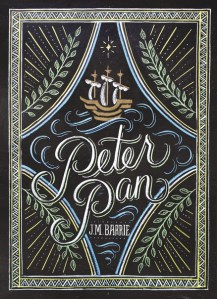
Review – Peter Pan by J. M. Barrie

Happy Hump Day,

Today I’ll review J. M. Barrie’s classic Peter Pan. I’ve been planning to read this book for ages and now that I’ve bought the beautiful Puffin Chalk edition with rough cut (oh I love rough cut), I finally felt ready to do so. First off, I have to admit that I’m heavily biased by Disney’s 1953 animated film Peter Pan, so reading the original came as a shock. But see for yourself.

Peter Pan
Image provided by Penguin US¹
Synopsis quoted from Penguin US¹:

One starry night, Peter Pan and Tinker Bell lead the three Darling children over the rooftops of London and away to Neverland–the island where lost boys play, mermaids splash and fairies make mischief. But a villainous-looking gang of pirates lurk in the docks, led by the terrifying Captain James Hook. Magic and excitement are in the air, but if Captain Hook has his way, before long, someone will be walking the plank and swimming with the crocodiles…

My Thoughts:

As we all know, Peter Pan is set in London and Neverland. Neverland is a special place that looks different for every child. Barrie compares its map to the map of a child’s mind. As far as setting goes, the description of Neverland is the most outstanding part of this novel. I also like how Barrie writes about the Lost Boys having to find the right hollow tree stump as a personal entryway into their underground home.

But now, the truth will be revealed: Our main character, famous Peter Pan, is an unlikeable, selfish fellow. I really came to hate him. And Wendy isn’t much better, because she just doesn’t get that Peter is using her. She is a very naive little girl who desperately wants to be a wife and a mother. The only characters I did like are the Lost Boys. They are a lot of fun to be around and remind me of a real bunch of boys quarrelling and having fun. Of course, all this doesn’t mean that J. M. Barrie was a bad writer, it just means that I grew up with a different version of Peter Pan and it’s hard for me to adjust to the harsh reality.

The first half of Peter Pan actually is so boring I was thinking of quitting the book. I am, however, not a quitter, so I read on and it did get better. You should know that this book is very different from what you see in the 1953 Disney movie. Neverland isn’t a shiny happy place with a couple of silly pirates causing trouble. It’s cruel. And Peter is too. So don’t read this book to small children. What Peter Pan does is, it gives a good impression of late 19th, early 20th century views on women and of what was expected of little boys and girls. So read it if you are interested in that, or if you want to score more points on all those 100-books-you-should-read lists.

3beans

¹ http://www.penguin.com/book/peter-pan-by-j-m-barrie/9780147508652

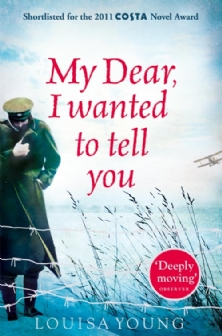
Review – My Dear, I Wanted to Tell You by Louisa Young

Hi,

The month is almost over and I’m a little behind on reviews. 😉 Today you’ll get another review that fits the Great War Centenary topic. I read Louisa Young‘s My Dear, I Wanted to Tell You which was shortlisted for the 2011 Costa Novel Award.

My Dear I Wanted to Tell You
Image provided by Harper Collins UK¹
Synopsis quoted from Harper Collins UK¹:

A letter, two lovers, a terrible lie. In war, truth is only the first casualty.

While Riley Purefoy and Peter Locke fight for their country, their survival and their sanity in the trenches of Flanders, Nadine Waveney, Julia Locke and Rose Locke do what they can at home. Beautiful, obsessive Julia and gentle, eccentric Peter are married: each day Julia goes through rituals to prepare for her beloved husband’s return. Nadine and Riley, only eighteen when the war starts, and with problems of their own already, want above all to make promises – but how can they when the future is not in their hands? And Rose? Well, what did happen to the traditionally brought-up women who lost all hope of marriage, because all the young men were dead?

My Thoughts:

Louisa Young’s historical novel My Dear, I Wanted to Tell You is set in early 20th century England and France. While Ms Young did thoroughly research the time the book is set in, I had problems envisioning the setting, especially the scenes that are set at the Western Front, even though I am familiar with what it looked like from pictures.

The novel’s main characters are Riley Purefoy, Nadine Waveney, Peter and Julia Locke as well as Rose Locke, but those who most stand out are Riley and Julia. Riley, whose life we witness from his boyhood onwards, goes through a lot of changes and there comes a time when he even turns into a quite unlikeable fellow. Nevertheless, his character always stays believable. Julia Locke is the perfect characterization of a wife without purpose. Staying at home, nobody thinks her capable of doing something useful, so she slowly begins to lose her mind.

My Dear, I Wanted to Tell You starts out slow-paced but picks up so much speed in the second half that I wasn’t able to put it down. The novel switches between England and France, home and the Western Front. All main characters get their share of attention and so the reader is able to see the war and its effects from different perspectives. My Dear, I Wanted to Tell You gives us a glimpse of human tragedy and hope during the Great War and to add a little special something, Louisa Young provides insight into the history of the first successful plastic surgeries.

4beans

If you are interested in more info on the plastic surgeries done by Sir Harold D. Gillies, you can read his book Plastic Surgery of the Face online here: (Warning: Contains images of facial gunshot wounds): https://openlibrary.org/books/OL7141634M/Plastic_surgery_of_the_face

¹ http://www.harpercollins.co.uk/titles/9780007361441/my-dear-i-wanted-to-tell-you-louisa-young

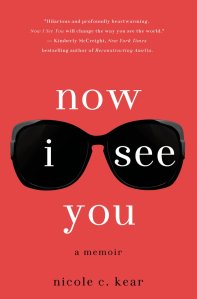
Review – Now I See You by Nicole C. Kear

Hi,

Today is the publication day of Nicole C. Kear‘s memoir Now I See You. I’ll introduce you to it down in my review. Thank you St. Martin’s Press for providing me with an e-galley!

Now I See You
Image provided by St. Martin’s Press¹
Synopsis quoted from St. Martin’s Press¹:

At nineteen years old, Nicole C. Kear’s biggest concern is choosing a major–until she walks into a doctor’s office in midtown Manhattan and gets a life-changing diagnosis. She is going blind, courtesy of an eye disease called retinitis pigmentosa, and has only a decade or so before Lights Out. Instead of making preparations as the doctor suggests, Kear decides to carpe diem and make the most of the vision she has left. She joins circus school, tears through boyfriends, travels the world, and through all these hi-jinks, she keeps her vision loss a secret.

When Kear becomes a mother, just a few years shy of her vision’s expiration date, she amends her carpe diem strategy, giving up recklessness in order to relish every moment with her kids. Her secret, though, is harder to surrender – and as her vision deteriorates, harder to keep hidden. As her world grows blurred, one thing becomes clear: no matter how hard she fights, she won’t win the battle against blindness. But if she comes clean with her secret, and comes to terms with the loss, she can still win her happy ending.

My Thoughts:

Where I live, you don’t often meet blind or visually impaired people walking the streets with the aid of a stick, but when I do happen to cross paths with them, I’m often at a loss because I don’t know how to react. Should I just pass them in a normal way? Should I stand back, so it’s easier for them? Or would acting normal make it easier? Can they hear me? What would it be like if I were this blind person? I guess I’m not the only one asking themselves these questions.

When I encountered Nicole C. Kear’s Now I See You, I thought, “You have to read this book”! How often do you get an opportunity to read a memoir by someone who loses their sight? What’s more, Nicole C. Kear is an avid reader. Just think about that for a minute. You are gradually losing your sight and you love to read. That’s a hefty blow.

Now I See You is a memoir that is as engaging and easy to read as a novel. It tells Kear’s story from the moment she learned that she would lose her eyesight up until the moment she learned to live without it. The author shares everyday situations as well as very personal and intimate moments like the birth of her children. Her first child’s birth is told especially vivid and with a good portion of humor. The latter is what I liked very much about this book – it shows that Nicole C. Kear might have lost most of her eyesight but not her sense of humor.

No matter if you feel insecure around the visually impaired or not, I can only recommend that you read this insightful memoir. Now I See You opened my eyes.

4beans

¹ http://us.macmillan.com/nowiseeyou/NicoleCKear

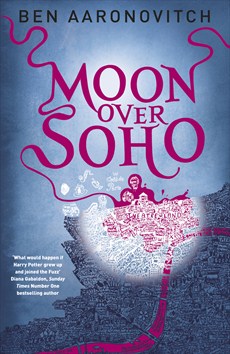
Review – Moon Over Soho by Ben Aaronovitch

Hi,

Right after finishing Rivers of London, I had to continue with book number two in Ben Aaronovitch‘ Peter Grant series, Moon Over Soho. And here is what I think about it.

Moon Over Soho
Image provided by Orion Publishing Group¹
Synopsis quoted from Orion Publishing Group¹:

I was my dad’s vinyl-wallah: I changed his records while he lounged around drinking tea, and that’s how I know my Argo from my Tempo. And it’s why, when Dr Walid called me to the morgue to listen to a corpse, I recognised the tune it was playing. Something violently supernatural had happened to the victim, strong enough to leave its imprint like a wax cylinder recording. Cyrus Wilkinson, part-time jazz saxophonist and full-time accountant, had apparently dropped dead of a heart attack just after finishing a gig in a Soho jazz club. He wasn’t the first.

No one was going to let me exhume corpses to see if they were playing my tune, so it was back to old-fashioned legwork, starting in Soho, the heart of the scene. I didn’t trust the lovely Simone, Cyrus’ ex-lover, professional jazz kitten and as inviting as a Rubens’ portrait, but I needed her help: there were monsters stalking Soho, creatures feeding off that special gift that separates the great musician from someone who can raise a decent tune. What they take is beauty. What they leave behind is sickness, failure and broken lives.

And as I hunted them, my investigation got tangled up in another story: a brilliant trumpet player, Richard ‘Lord’ Grant – my father – who managed to destroy his own career, twice. That’s the thing about policing: most of the time you’re doing it to maintain public order. Occasionally you’re doing it for justice. And maybe once in a career, you’re doing it for revenge.

My Thoughts:

In Moon Over Soho, we’re back in present-day London and author Ben Aaronovitch still helps us to create vivid images of the book’s setting in our minds. However, the history and architecture that impressed me in Rivers of London now fade into the background.

My favorite character shares this fate. In Moon Over Soho, Inspector Nightingale is a secondary character like many others in the book. Most of the time, he stands on the sidelines and doesn’t even watch what’s going on around the main character Peter Grant, who slowly turns into a testosterone-driven guy, unable to think clearly.

The plot of Moon Over Soho is quite engaging with an unhurried pace. The book picks up right where Rivers of London left off and it doesn’t flood you with information that you already have if you’ve read Rivers. If you aren’t that big a fan of Inspector Nightingale and historical facts, I’m sure this book will please you. For me, these two are important elements that make the series worthwhile. Moon Over Soho is a solid read, but cannot live up to Rivers of London.

3beans

¹ https://www.orionbooks.co.uk/books/detail.page?isbn=9780575097629

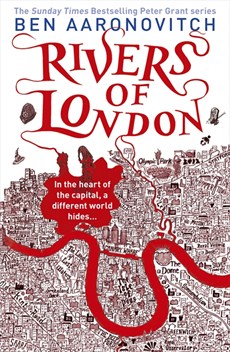
Review – Rivers of London by Ben Aaronovitch

Hello,

Last Saturday, I was finding myself in a post-exam void, so it was the perfect time for me to finally raid my dad’s bookshelf and grab his copy of Ben Aaronovitch‘s Rivers of London. And this is what happened:

I was instantly hooked. After years of reading gazillions of vampire series that had started mixing up in my mind, I had sworn myself not to start another series for at least another year. But then there was my dad reading Ben Aaronovitch, telling me that the Peter Grant series was fun and clever. After my exam I needed something light and so I couldn’t resist any longer.

Rivers of London
Image provided by Orion Publishing Group¹
Synopsis quoted from Orion Publishing Group¹:

My name is Peter Grant and until January I was just probationary constable in that mighty army for justice known to all right-thinking people as the Metropolitan Police Service (and as the Filth to everybody else). My only concerns in life were how to avoid a transfer to the Case Progression Unit – we do paperwork so real coppers don’t have to – and finding a way to climb into the panties of the outrageously perky WPC Leslie May. Then one night, in pursuance of a murder inquiry, I tried to take a witness statement from someone who was dead but disturbingly voluable, and that brought me to the attention of Inspector Nightingale, the last wizard in England.

Now I’m a Detective Constable and a trainee wizard, the first apprentice in fifty years, and my world has become somewhat more complicated: nests of vampires in Purley, negotiating a truce between the warring god and goddess of the Thames, and digging up graves in Covent Garden . . . and there’s something festering at the heart of the city I love, a malicious vengeful spirit that takes ordinary Londoners and twists them into grotesque mannequins to act out its drama of violence and despair.

The spirit of riot and rebellion has awakened in the city, and it’s falling to me to bring order out of chaos – or die trying.

My Thoughts:

Rivers of London is mainly set in present day London but those of us who have a soft spot for dated architecture won’t be disappointed. There’s enough of it in this book to make your heart beat faster. Did I mention that Mr Aaronovitch even gives us a library? An old one. Actually there is more than one, but he describes one of them in enough detail for me to fall in love with it. (Okay I’m a bookaholic and a history student, I might not be a reliable source in those matters.)

Peter Grant, our main character, is an apprentice wizard and police constable. He is a very likable fellow and great to be around. You really want to be friends with him. There is, however, another character in Rivers of London that I felt more drawn to: Inspector Nightingale. Inspector Nightingale, who likes to dress in an old-fashioned way, is clever and mysterious which somehow seems to make him attractive.

Rivers of London takes you on a fast-paced hunt for a mysterious murderer. As a matter of fact, the novel’s pace sometimes gets so fast I had to reread certain passages to make sense of what was happening. Rivers of London combines a great sense of humor with loads of interesting facts about English history and architecture and this is what makes the novel special. If you are interested in history, but you’d like to try urban fantasy for a change, Rivers of London might just be the book for you.

4beans

¹ https://www.orionbooks.co.uk/books/detail.page?isbn=9780575097582