I Won – An Awesome Bag

Hi there,

I’m quite busy right now and the heat wave is still there. I just finished reading another book and you’ll get a review soon – pinky promise 🙂

Last week I won something awesome that I wanted to show you. Like many of my colleagues studying English, I struggle with Denglish, that is constantly mixing German (Deutsch) and English. It’s a wonderful language of its own, but stylistically, it’s terrible. So I was more than happy when I found out that I won an accessory that fits my terrible habit: a Denglish tote bag. And here it is (also included in the picture are all the great goodies that came with it. And please note the beautiful stamps)

denglish

I won this great bag at Lovelybooks and if you like it, you can get one for yourself, or your mom, or your friend at The Hipstery. They also have other great Germany related things. To promote the items at The Hipstery, Adam Fletcher, one of the owners of the store, even wrote a book. It’s called How To Be German In 50 Steps and it is written in German and English. He even works on another book called Denglish For Better Knowers. How awesome is that? (Yep another awesome there. I love Denglish)

If you have any questions concerning the meaning of any of the things written on the tote bag. Just ask me. I’d be happy to help. I’m sure they don’t make any sense to someone who doesn’t speak German 😀
Review – Perfect

Hello again,

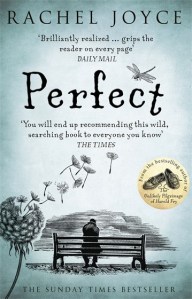
Last week I received a review copy of Perfect by Rachel Joyce. Lovelybooks and RandomHouse UK (Doubleday) had another great cooperation (oh how I love them for these, I can’t say it enough) and I received the copy to participate in a Lovelybooks book discussion.

Perfect
Image provided by Black Swan¹
Summary quoted from RandomHouse UK¹:

Summer, 1972: In the claustrophobic heat, eleven-year-old Byron and his friend begin ‘Operation Perfect’, a hapless mission to rescue Byron’s mother from impending crisis.

Winter, present day: As frost creeps across the moor, Jim cleans tables in the local café, a solitary figure struggling with OCD. His job is a relief from the rituals that govern his nights.

Little would seem to connect them except that two seconds can change everything.
And if your world can be shattered in an instant, can time also put it right?

My Thoughts:

Perfect is set in England in the 1970s and in the present. I really enjoyed how Rachel Joyce described different processes. Like for example the process of sugar cubes being dropped into cups of tea. She does that brilliantly.

The main characters are a boy called Byron and a man called Jim. Unfortunately, I wasn’t able to connect that well with Byron. Maybe it also has to do with the storytelling. I’ll talk about that later on. I was however perfectly able to empathize with Jim. I was able to feel every single emotion he felt. And many of them weren’t that pleasant. So be aware that this book is only for people who aren’t depressed, because it will most probably make you feel depressed.

As I already mentioned above, Perfect features two main characters. There are two strings of storyline – one set in the 1970s and wrapping around Byron’s life, and one set in the present, telling us more about Jim. In my opinion Byron’s story, which seems to be the main plot, is really slow-paced. This might also have to do with it being written in past tense. More than once, I caught myself looking forward to another chapter about Jim. To me, Jim’s story seems much more lively, probably because it written in present tense and because it really is much more lively. There are things happening in Jim’s storyline, whereas a lot of Byron’s storyline is spent planning and waiting. I also missed a real climax in the book. As I mentioned before, I really liked how Ms. Joyce described processes. This is fine writing. Still, I was a little disappointed after all the praise I’ve read about Perfect. I’d recommend it to people who don’t mind a slow and depressing read.

3 Star Rating: Recommended

¹ http://www.randomhouse.co.uk/editions/perfect/9780552778107

DIY Postcard – Summer, Sun, Far Off Places

Hello dear reader chum (okay I stole that from Miranda Hart),

As you all know, in June, I participated in a reading challenge. One of the tasks we had to do was to mail something to Karla of the Lovelybooks team that had to do with Summer, Sun and Far Off Places. We were instructed not to send valuable items (no bribes) and the item/s should fit into an envelope or similar.

So I decided to craft a postcard that had to do with the book the challenge was about. (At that point, I hadn’t even received the book)

Card1


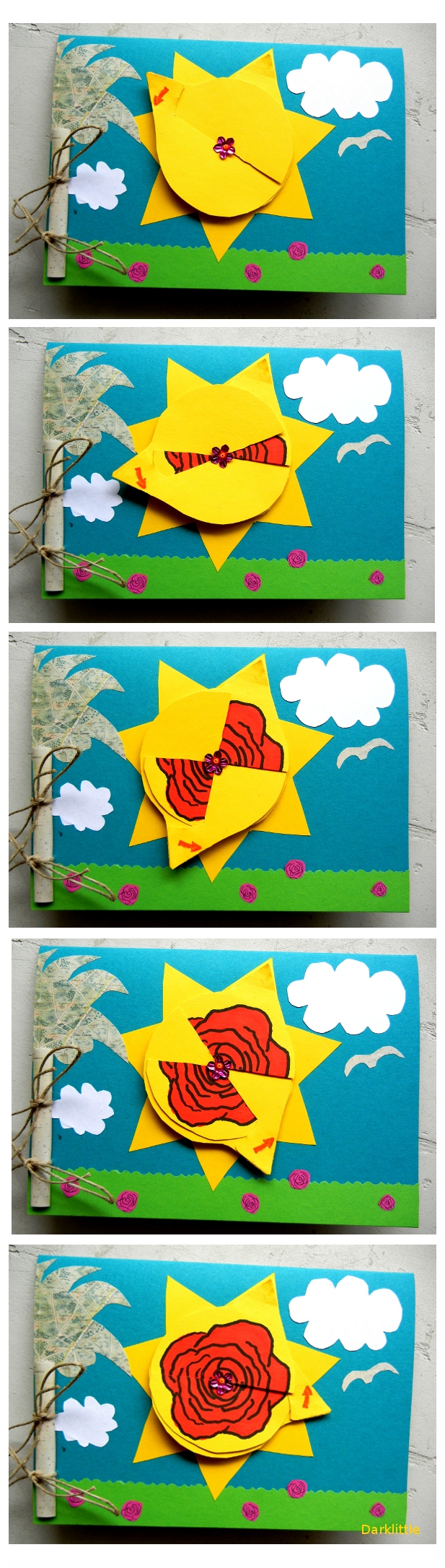
This is the front of the card. The palm tree on the left is made of a map of Montevideo (the book is called Die Rosen von Montevideo). If you unroll the palm tree’s trunk, there is a message that tells you (in an elaborated way) that you should find out what secret the sun holds and that you will find out about wonders which only the sun is able to perform. It also tells you to let the wind blow through the bay, over to the other shore and that there, in the shade, you will find yet another message. 🙂

Well, as you can see, that palm tree is not the only interesting thing on that first page of my card. There is the sun. And it is supposed to hold a secret. Now you probably peeked while reading and found out what wonders the sun is able to perform. 🙂

I remember these changing pictures from a children’s book I had (and recently bought in a used book shop) and thought “I wanna try making one of those!”. And so I did. I found an easy tutorial on Extreme Cards and tried it. As you can see, it worked 🙂


Card2

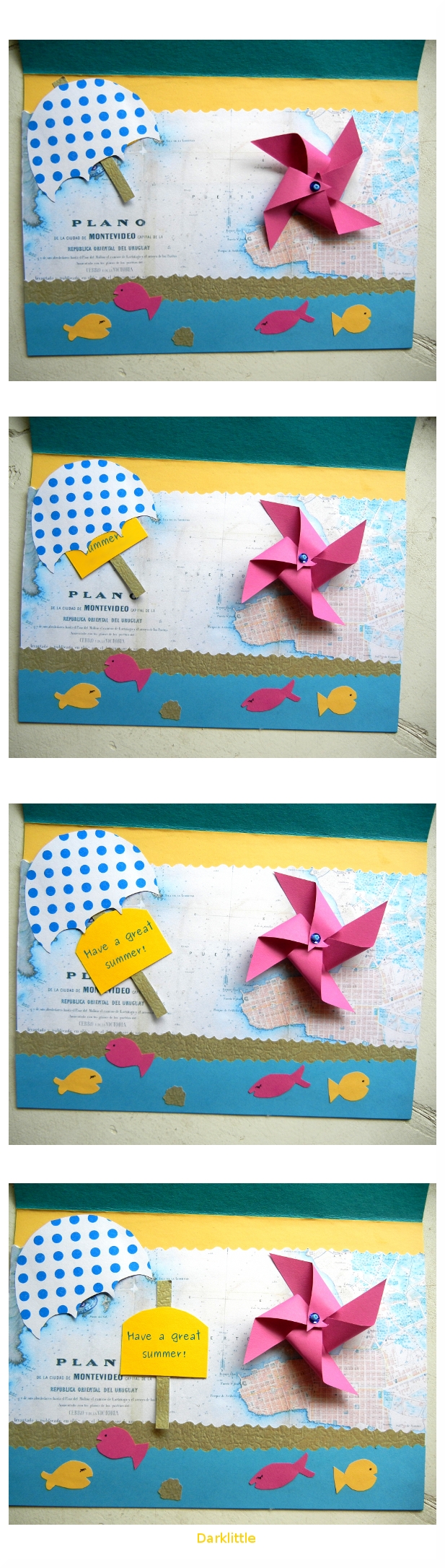
Now on to the inside of my card. Here you can see the sea (with a few fish and a shell) and a map of Montevideo in the 19th century (we gotta stay true to the book haha). As I wrote in my little palm tree note, the reader now has to let the wind blow through the bay, and if they do so, the little pin wheel will turn (cute eh?).

Then we’ll travel on with the wind to the other shore (where it’s quite hot and sunny I’m afraid). But what’s that? A dotted umbrella that promises shade. And didn’t that note say something about shade too? Well let’s go over there. I’m hot!

Something seems to be loose on that umbrella. I’ll pull. Haaaa… Look there! A message!

Actually, the original message was a little different but this one is for you!

Review – Die Rosen von Montevideo (Deutsche Version)

Wie bereits angekündigt, gibt es zwei Blog Posts zu diesem Buch. Das ist nun der Zweite in Deutscher Sprache. Es geht in dieser Review um das Buch Die Rosen von Montevideo von Carla Federico welches ich bei Lovelybooks gewonnen habe.

Bild von Droemer Knaur¹
Inhalt übernommen von Droemer Knaur¹:

Montevideo 1843. Der Frankfurter Bankierssohn Albert Gothmann verliebt sich Hals über Kopf in die lebenslustige Rosa, Tochter einer der ältesten spanischen Familien Uruguays. Doch ihre Liebe zwingt sie zum Verzicht auf ihre Heimat, ein Schicksal, das fortan alle Nachfahrinnen ihrer Familie teilen. Sind die Frauen stark genug, um für ihre Leidenschaft zu kämpfen?

Meine Gedanken zum Buch:

Die Rosen von Montevideo spielt hauptsächlich im Uruguay und Deutschland des 19. Jahrhunderts. Die Autorin Carla Federico beschreibt die historischen Vorgänge dieser Zeit sehr umfassend und gibt so einen guten Einblick in die Zeit in der das Buch spielt. Auch die Landschaft in Südamerika ist meiner Meinung nach gut beschrieben. Sobald es um kleinere räumliche Einheiten geht, werden die Beschreibungen der Handlungsorte etwas karger.

Da Die Rosen von Montevideo eine Familiensaga ist die sich über mehrere Generationen spannt, gibt es mehrere Hauptfiguren. Anfangs konnte ich mich noch gut in die Lage der ersten Hauptfigur Rosa hinein versetzen, aber je weiter die Geschichte voranschritt und je mehr Figuren dazukamen, desto schwerer fiel es mir mich mit den Figuren zu identifizieren. Außerdem fällt auf, dass die Figuren sich sehr ähnlich (wenn nicht schon stereotyp) sind. Das lässt sich allerdings nicht nur durch Verwandtschaft erklären. So sind sich zum Beispiel Albert, Luis und Antonio von ihren Eigenschaften her wirklich sehr ähnlich, obwohl nur Luis und Antonio miteinander verwandt sind. Ähnliche Parallelen lassen sich auch bei den Frauen ziehen.

Was die Parallelen betrifft, so gab es von diesen in der Handlung mehr als genug. Anfangs war die Verwendung von Parallelen wirklich ein gelungenes Stilmittel, das ich sehr zu schätzen wusste. Mit der Zeit wurden diese Parallelen jedoch zur Qual und eigentlich nur noch langweilig. Hier ist weniger oft mehr.

Generell muss ich sagen, dass mit Die Rosen von Montevideo für meinen Geschmack wohl zu viel auf einmal versucht wurde. Die Mischung aus Liebesgeschichte, Drama, Historienroman und Familiensaga hat mich einfach überwältigt. Hier wäre locker Stoff für drei Bücher vorhanden gewesen. Ich will damit nicht sagen, dass mir das Buch gar nicht gefallen hat. Es hat mich vor allem im ersten Drittel gut unterhalten und auch die historischen Hintergrundinformationen waren sicher gut recherchiert.

Mein Fazit: Ein Roman für historisch Interessierte die drei Generationen junger Frauen auf ihrem holprigen und und von Parallelen geprägten Kampf ums Glück begleiten wollen.

bohnen3s
¹ http://www.droemer-knaur.de/buch/7768688/die-rosen-von-montevideo

Review – Die Rosen von Montevideo (English Version)

Okay, it’s decided. I’m doing two separate blog posts on this book. This one in English and a second one in German. They are basically the same (content wise). I’m doing this because I need to post an all-German blog post for this reading challenge I’m in which is all about this book I am reviewing: Die Rosen von Montevideo by Carla Federico. 🙂 I won this book at Lovelybooks.

Image linked from Droemer Knaur¹
Summary (freely translated – original: Droemer Knaur¹):

Montevideo 1843. Albert Gothmann, a banker’s son from Frankfurt, falls in love with cheerful Rosa, daughter of one of the oldest Spanish families in Uruguay. This love forces Rosa to part with her native land – a fate that her descendants will share with her. Will these women be strong enough to fight for their happiness?

My Thoughts:

The book Die Rosen von Montevideo is mainly set in 19th century Uruguay and Germany. Carla Federico manages to give good insight into the time the book is set in by describing various historical happenings. I also liked how she depicted the South American landscape. As soon as Ms. Federico starts to write about smaller spacial entities, the descriptions are getting a little more vague.

As Die Rosen von Montevideo is a family saga that spans several generations, there is more than one main character. In the beginning, it was easy to empathize with the first main character Rosa but the farther I read, the harder it got to identify with all those characters. The characters are very similar to one another (some are very stereotypical). This is something that cannot only be explained by the characters being relatives because Albert, Luis and Antonio have very similar character traits but only Luis and Antonio are related. Similar parallels can also be drawn among the female characters in the novel.

Concerning parallels: There were more than enough of them in this novel. What started out as a great stylistic device, soon turned into something that pained me and in the end even bored me. Sometimes, less is more…

It seems to me, that with Die Rosen von Montevideo Ms. Federico tried too much at once. The mix of love story, drama, historical fiction and family saga was too much for me. In my opinion, this book contains ideas that could have filled 3 books. I wouldn’t say that I didn’t like the book. I particularly enjoyed the first third and I also liked the historical background information.

My conclusion: A book for readers who are interested in history and who want to follow 3 generations of young women on their long and hard fight for happiness.

bohnen3s
¹ http://www.droemer-knaur.de/buch/7768688/die-rosen-von-montevideo

Review – Inferno

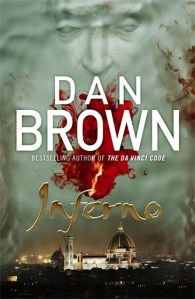
Thanks to Lovelybooks and Random House UK (Bantam Press), I won a copy of Dan Brown’s Inferno.

Inferno
Image provided by Random House UK¹
Summary quoted from Random House UK¹:

Seek and ye shall find.”

With these words echoing in his head, eminent Harvard symbologist Robert Langdon awakes in a hospital bed with no recollection of where he is or how he got there. Nor can he explain the origin of the macabre object that is found hidden in his belongings.

A threat to his life will propel him and a young doctor, Sienna Brooks, into a breakneck chase across the city of Florence. Only Langdon’s knowledge of hidden passageways and ancient secrets that lie behind its historic facade can save them from the clutches of their unknown pursuers.

My thoughts:

– This review might contain light spoilers –

I cannot write too much about where Inferno is set because that would give away too much of the plot. Inferno’s plot starts in Florence and Mr. Brown made the Florentine atmosphere believable for me. I have been to Florence and one other city he describes in greater detail before, so I don’t know if that could also play a role.

Robert Langdon is a very nice character. I could easily relate to him. I also had no problems with Sienna, who is his companion for most of the book. After about three-quarters of the book there were some problems with the characters that also had to do with the plot. There was a plot twist and, in my opinion, that plot twist made a lot of characters lose all credibility.

Overall, the plot is full of suspense and the first 200-300 pages are so full of action that I always thought I needed some breathing space. Nevertheless, these first 300 pages also seemed somehow lengthy. Unfortunately, I can’t really grasp what made me think that. I can only say that the remaining ~200 pages went by much quicker and were a more relaxing read with a lower heart rate involved.

This was my first book by Dan Brown and it was definitely not boring. (Although there were some lengthy parts that were less interesting.) Still, Inferno has its weaknesses. I had many issues with character credibility. (It’s also embarrassing when readers find the answer to a letter riddle much faster than Langdon and a very intelligent person) Overall, Inferno is a book for people who are already fans of the series, or who are interested in a thrill ride that involves art, literature, history and a secret I’m not going to tell.

bohnen3s

¹ http://www.randomhouse.co.uk/editions/inferno/9780593072493

Reading – Inferno

As I’ve already promised, I’ll tell you about the other book I’m reading right now. The best seller 🙂 It’s Inferno by Dan Brown and I won it at Lovelybooks. It is the English version of the book and it was sponsored by Random House UK. I am so happy about this cooperation between Lovelybooks and Random House UK and I hope it wasn’t the last one.

This is the first book by Dan Brown that I’m reading and I’m enjoying it. I only knew the movie The DaVinci Code, so I had no idea what I was getting myself into with this book. So far, Inferno is a smooth read and quite exciting. We’ll see if it stays like that.

Image linked from Random House UK¹
Summary quoted from Random House UK¹:

‘Seek and ye shall find.’
With these words echoing in his head, eminent Harvard symbologist Robert Langdon awakes in a hospital bed with no recollection of where he is or how he got there. Nor can he explain the origin of the macabre object that is found hidden in his belongings.
A threat to his life will propel him and a young doctor, Sienna Brooks, into a breakneck chase across the city of Florence. Only Langdon’s knowledge of hidden passageways and ancient secrets that lie behind its historic facade can save them from the clutches of their unknown pursuers.

¹ http://www.randomhouse.co.uk/editions/inferno/9780593072493

Lovelybooks – Free Bookmarks

Hi there,

Lovelybooks is offering free bookmarks right now. They are super cute, but have a look yourself. You can order them here: click (I’m sorry, this page is German. They’ll probably send the bookmarks all over the EU as the postage is the same within the EU. There seems to be no country restriction).